
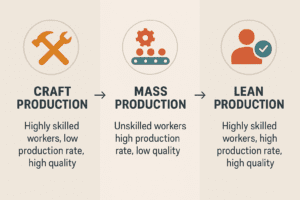
From Craft to Lean Production within Services
The good news is there’s a solution. A Lean operating model focuses on smooth workflow, building quality into each step, and valuing people. This approach can help you get better results faster and at a lower cost, even in service industries.
Here’s how Lean can work in service organizations. First, we’ll look at the main production models and their impact. Then, we’ll cover practical ways to use Lean principles in service settings.
Check out Leanademy’s training options
Craft in Services: High Skill, High Quality, Limited Scale
What it looks like in services
- Work performed end-to-end by a single skilled worker or small team.
- Decisions made close to the work; high ownership and accountability.
- Highly tailored, often low error rates, but slower throughput and higher unit cost
Strengths:
- Deep domain expertise; quality built in.
- Better customer experience on complex, variable work.
- Easier root-cause analysis—one person sees the whole process.
Limitations:
- Hard to scale; throughput constrained by individual capacity.
-
Inconsistent methods without standardized work.
-
Vulnerable to variation when experts differ in approach.
Where it shines today:
Mass Production in Services: Specialization and Scale, But Watch Out for Hidden Costs
What it looks like in services:
- Work is split into many narrowly defined tasks performed by different people or teams.
- Often offshored or centralized; heavy reliance on rigid SOPs and handoffs.
- Higher apparent throughput and lower labor rates, but poorer first-pass quality.
- Low-skill execution increases error rates.
- Rework loops multiply; new teams created for quality control and remediation.
- Growing “inventory of errors” waiting to be fixed delays customer outcomes.
- Longer end-to-end cycle times, despite “fast” individual steps.
- Culture of pass-the-baton vs. own-the-outcome.
In banking (real client pattern): When work was split into 10+ micro-tasks across offshore teams, throughput initially spiked but quality tanked. Rework flowed back to original groups, volumes ballooned, and leaders had to add rework departments to keep up. This resulted in a higher total cost, lower customer satisfaction, missed SLAs, and angry stakeholders.
Why does this happen? Mass production focuses on local efficiency, not on the overall value of the process. In services, the product is information, decisions, and customer results, and errors cost more than they seem. For example, in a loan center, a simple data entry mistake on a customer’s application can result in a declined loan, leading to a complaint, an internal review, regulatory reports, and even the loss of a client. Every mistake causes extra work, escalations, customer calls, and regulatory risks.
Lean for Services: Quality at the Source, Flow, and Respect for People
Core Lean principles for services:
- Value: Define the outcome the customer truly needs (accurate, timely decisions; no rework; clear communication).
- Flow: Reduce handoffs and batching; design work to move smoothly from start to finish.
- Quality at the source: The person doing the work prevents defects via clear standards, checks, and feedback.
- Pull: Do work when it’s needed based on demand. This helps prevent large queues and old backlogs.
- Respect for people: Invest in skills; give teams authority to improve and own outcomes.
How Lean differs from mass production in services:
- Cross-functional capability over extreme specialization.
- Standard work + problem-solving over rigid SOPs with no feedback loop.
- Smaller teams owning end-to-end value over many handoffs.
- Visual management and daily triage over periodic firefighting.
Why Skill Development Is Essential for Lean Success
Check out Leanademy’s Training Options
- Lean requires problem-solving at the front line, not just leadership mandates.
- Teams need to interpret data, identify waste, and run PDCA cycles.
- Leaders must coach daily, not just manage metrics.
A Practical Roadmap: Moving From Mass to Lean in a Banking or Service Context
1) Map the End-to-End Value Stream (Not Just the Org Chart)
- Document the customer journey or case lifecycle from intake to resolution.
- Capture data per step: lead time, touch time, queue time, defect rate, handoffs, rework loops.
- Identify where the inventory of errors sits and why it accumulates. Deliverable: A value stream map that shows bottlenecks, rework hot spots, and WIP.
2) Quantify the True Cost of Poor Quality (COPQ)
- Calculate first-pass yield (FPY) and rolled throughput yield (RTY).
- Measure cost in extra work, delays, escalations, regulatory risks, refunds, and customers leaving. A case that reframes “cheap labor” as expensive errors.
3) Redesign Work for Flow and Quality
- Reduce handoffs: Combine steps into skill-building teams or groups that handle the whole process from start to finish.rk: Clear definitions of “done,” checklists, job aids, and built-in quality checks.
- Introduce quality at the source: error-proofing, templates, clear decision rules, and automated checks. queues, triage rules, and pull scheduling to stop aging inventory. Tip: Start with the area that has the most volume and the most defects. Get a quick win there, then build on that success.
4) Upgrade Skills and Roles
- Move away from “10 micro-specialists” to multi-skilled workers who can do several steps and make smart decisions.
- Provide targeted training (Lean fundamentals, problem-solving, domain knowledge).
- Set up coaching and daily meetings, with managers acting as problem solvers, not just schedulers.
5) Build Daily Management & Visual Controls
- Tiered huddles (team → manager → leadership) focused on flow, quality, and blockers.
- Visual boards for backlog, WIP, SLA risk, defects, and improvement actions.
- Quick PDCA cycles (Plan-Do-Check-Adjust) to fix problems fast.
6) Measure What Matters and Tie It to Customer Outcomes
- Track FPY, RTY, cycle time, WIP age, touch time, handoffs per case, and defects per 100 cases.
- Connect metrics to customer promises: fewer touchpoints, faster resolution, and accurate decisions.
- Share your before-and-after results and celebrate improvements. Building a positive culture comes from these wins.
Ready to Move From Fragmentation to Flow? Start With Training
If your service operation is stuck in a mass production model with high output, low quality, and lots of rework, Lean can help you find the right balance between quality, speed, and cost. But here’s the truth: tools alone won’t fix broken processes. You need people who understand Lean principles and use them every day.
That’s why training is the foundation of transformation. When your teams learn Lean Six Sigma methods, they gain the ability to:
- Spot waste and rework drivers in real time.
- Redesign processes for flow and quality at the source.
- Use data to make decisions, not assumptions.
- Lead rapid improvement events.